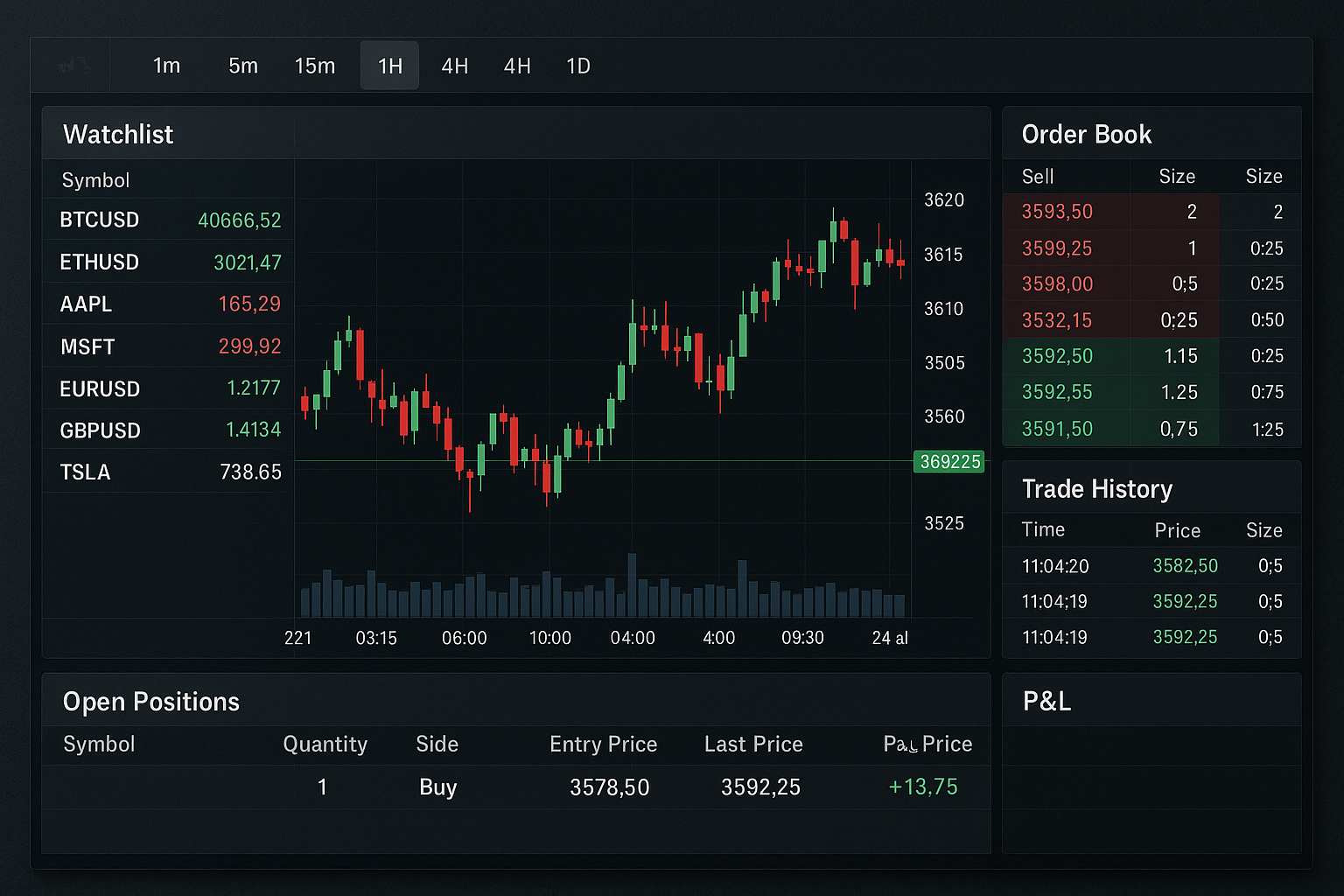
In 2026, most investors still manage their portfolios the way their parents did: scattered spreadsheets, fragmented data across different platforms, and decisions made on information that's already days or weeks old. Meanwhile, markets have accelerated. A policy announcement reshapes credit conditions in hours. Volatility spikes across asset classes within minutes. By the time you've gathered the pieces and run your analysis, the picture has shifted again. Norden Core exists to solve this exact problem: it brings all your financial positions into one real-time view, powered by AI that understands context and correlation in ways manual review never can.
This isn't a tool designed to make you trade faster or chase short-term gains. It's built for the opposite reason: to give you clarity when it matters, so your long-term decisions rest on solid ground. Whether you're managing a personal investment portfolio, steering a growing business, or monitoring exposure across volatile markets, Norden Core translates raw data into the kind of insight that actually changes how you think about your money. The result is fewer, better-informed decisions made with confidence rather than guesswork.
| Feature | Traditional Tools | Norden Core |
|---|---|---|
| Data Integration | Manual, fragmented across platforms | Real-time consolidation across all positions |
| Analysis Speed | Weekly or monthly reports | Continuous, refreshed as markets move |
| Scenario Testing | Static models, rarely updated | Stress testing in real time across multiple conditions |
| Risk Visibility | Individual assets viewed separately | Correlated risk across entire portfolio |
| Decision Support | Recommendations based on partial data | Transparent, structured reasoning with full context |
À retenir
Norden Core brings together all your financial data in one place and uses AI to spot patterns, test scenarios, and surface the risks that matter. Unlike spreadsheets or fragmented platforms, it works in real time as markets move. You stay in control of every decision, but with far clearer visibility into what you're actually exposed to and what might happen next.
What Is Norden Core and How Does It Differ From Traditional Financial Tools?
From Manual Spreadsheets to Real-Time Intelligence
For decades, the standard way to manage money was to pull data from different accounts, paste it into spreadsheets, run formulas, and hope nothing changed before your analysis was finished. If you held stocks, bonds, property, and business assets simultaneously, you'd be juggling multiple documents, each one outdated the moment you created it. This approach worked when markets moved slowly and quarterly reporting cycles made sense. It no longer does.
Norden Core replaces that fragmented workflow with a single consolidated view. Every position, every asset class, every piece of exposure flows into one interface. The AI engine continuously ingests new price data, credit announcements, volatility readings, and policy changes. Instead of waiting for your monthly review, you always know where you stand. When a market moves, your full picture updates within minutes. When a risk emerges, you see it first, not last. This shift from periodic snapshots to continuous clarity changes everything about how confidently you can make decisions.
Why Markets Move Faster Than Your Analysis Can Keep Up
A central bank raises rates. Credit spreads widen. An earnings surprise reshapes sector valuations. Geopolitical news affects commodity prices. Each of these events travels at digital speed, but your understanding of what it means for your portfolio typically lags by days or weeks. By the time you've synthesized the news, checked your positions, and understood the cascade effect across your holdings, the opportunity or risk has often passed.
Markets in 2026 operate on a timescale that manual processes simply cannot match. A portfolio manager reviewing spreadsheets once a week is flying blind for six days. A business owner checking their exposure monthly might miss signals that appear and evolve within hours. Norden Core closes that gap. Its models run continuously, stress-testing your positions against changing conditions in real time. You don't have to guess whether volatility in one asset class will ripple through another. You don't have to wonder if a rate shift changes your risk profile. The platform shows you, the moment the data arrives, what matters about today's market action relative to your specific situation.
How Norden Core's AI Engine Transforms Raw Data Into Actionable Decisions
Data Aggregation Across All Your Financial Positions
Most investors hold assets across multiple platforms: a brokerage account, a business bank, perhaps a pension, maybe property investments. Each one generates its own statements and updates independently. When you sit down to think about your overall exposure, you're manually stitching together information from five or six different sources. This fragmentation creates blind spots. You can't easily see how positions in one account are correlated with positions in another. You can't quickly calculate your true exposure to a particular sector, currency, or risk factor when holdings are scattered across platforms.
Norden Core connects these pieces. It securely aggregates data from multiple institutions into a single workspace. You set it up once, and from then on, every position across every account flows into the platform automatically. You no longer have to download statements, open multiple browsers, or manually enter data. The AI understands what each position is, how it behaves, and where it fits into your overall picture. Within seconds of connecting your accounts, you have a complete map of your exposure.
Stress Testing and Scenario Modeling in Real Time
Understanding what you own is the first step. Understanding what happens if conditions change is the second, and far more valuable one. A traditional financial plan might stress-test your portfolio once a year against a few predefined scenarios: "What if interest rates rise by 1%?" or "What if markets fall 20%?" But markets are constantly shifting. New scenarios emerge. Old assumptions need updating. A model built in January no longer reflects February's reality.
Norden Core's stress-testing engine runs continuously. You can see in real time how your portfolio would behave under different conditions: a sudden rate shock, a market correction, a widening in credit spreads, or a combination of shocks. You can build custom scenarios based on your own concerns. The platform shows you not just which positions would be affected, but by how much and why. This isn't theoretical. It's grounded in live market data and updated as conditions evolve. For a personal investor, this means you can sleep at night knowing your portfolio has been tested against real risks. For a business owner, it means you can stress your holdings against the kind of volatility you actually care about, not just textbook scenarios.
The Risk Optimization Engine That Stays Under Your Control
The most important feature of Norden Core is something you might not expect: it never takes a decision for you. The platform identifies risks, models outcomes, and suggests optimizations. But the final call stays in your hands. This is deliberate design. Long-term financial decisions deserve careful judgment, not algorithmic speed. You have the context, the values, and the constraints that no AI can fully understand. Norden Core's role is to give you the information you need to exercise that judgment well.
The risk optimization engine works like a co-pilot for your portfolio. It flags correlations you might have missed. It shows you positions that appear redundant. It identifies concentrated exposures. It tests whether a proposed trade would actually reduce your overall risk or just move it somewhere else. You review these insights, ask questions, adjust your thinking, and then decide. The platform responds to your preferences by tailoring its analysis. Over time, it learns what matters to you and surfaces recommendations that fit your actual needs rather than generic best practices.
Is Norden Core Secure Enough for Your Financial Data?
Zero-Knowledge Architecture and UK Data Standards
Connecting all your financial accounts to a single platform raises an obvious question: is my data safe? Norden Core uses zero-knowledge architecture, which means the platform can analyze your positions and run its models without ever having direct access to your data. Your account information, transaction history, and holdings remain encrypted and stored in your control. The platform receives only the aggregated signals it needs to run analysis. Even Norden Core's team cannot see your individual positions or account details unless you explicitly grant access for support purposes.
The architecture operates under UK data standards and follows the regulatory frameworks that govern financial data in the United Kingdom. This isn't offshore data handling. Your information stays within a jurisdiction with mature legal protections and transparent governance. Regular security audits verify the integrity of the system. Compliance with these standards is built into every layer of the platform, not bolted on as an afterthought.
Military-Grade Sovereignty by Design
Sovereignty means your data belongs to you and stays under your control. Norden Core was designed from the ground up around this principle. You decide which accounts to connect. You can disconnect at any time. Your data is encrypted both in transit and at rest. The company has no right to sell your data, use it for marketing, or share it with third parties without explicit consent. This level of sovereignty is rare among financial platforms. Many competitors monetize user data as a business line. Norden Core treats that as a violation of trust.
The technical implementation backs up this commitment. Multi-layer encryption, regular penetration testing, and a security-first development process ensure that even if someone tried to access your data, the technical barriers would make it impractical. Your financial information is not sitting in an open database where a breach could expose millions of users at once. It's compartmentalized, encrypted, and controlled.
Regulatory Compliance Built Into Every Feature
Norden Core doesn't treat compliance as a compliance department's problem. It's woven into product design. Data retention policies, encryption standards, and access controls are implemented at the code level, not managed manually. This means compliance doesn't weaken over time as people bypass safeguards. It stays constant because it's structural.
The platform maintains detailed audit trails. Every access to your data is logged. If you ever need to demonstrate that your financial decision-making process was grounded in proper analysis and supported by documented reasoning, those records exist. For business owners subject to audit, investors preparing for financial reviews, or anyone who needs to justify decisions to regulators or stakeholders, this transparency is invaluable. Your data is not just secure; it's accountable.
Norden Core in Practice: Real Before-and-After Examples
Personal Investment Portfolio Management
Consider Sarah, an investor who had built a portfolio over fifteen years through a mix of channels: stocks through a brokerage, bonds through a separate account, some real estate, and a business stake in a company held through her accountant. She was doing well, but she had no clear sense of what her total exposure looked like. Were her holdings too concentrated in one sector? How correlated were they? What would happen if interest rates spiked or equities fell sharply?
Before Norden Core, Sarah was running three separate analysis tools and a spreadsheet. It took hours each month to consolidate data. She often had questions she couldn't answer quickly: "If I sell my bond position, will that actually reduce my overall interest rate risk?" Answering that meant manually recalculating correlations.
After connecting her accounts to Norden Core, Sarah got a unified picture within days. The platform showed her that despite holding what felt like diversified assets, over 60% of her portfolio was exposed to interest rate risk through different channels. A rate spike would hurt her across multiple positions, not just her bond holdings. It also flagged that two of her stock positions were highly correlated, creating hidden concentration. Armed with this visibility, Sarah restructured her portfolio with confidence. She kept the same risk appetite but distributed it more thoughtfully. Six months later, when the central bank did raise rates, she wasn't caught off guard. She'd already positioned herself for that scenario.
Small Business Financial Planning
James runs a growing software company and holds the business assets, owner distributions, and personal investments across different accounts. Each one moved on its own timetable, and he struggled to see the forest for the trees. When he considered major decisions like whether to reinvest profits or pay himself a dividend, he didn't have a clear sense of how that choice affected his total financial picture. Was he over-exposed to company risk? If business revenue dropped, would his personal assets cover his obligations?
Before Norden Core, James worked with a traditional financial advisor once a year. By the time he got advice, conditions had shifted. The business had grown or contracted. New opportunities had emerged. He was making decisions on stale information.
Norden Core changed his workflow. He now has a real-time view of business cash, owner distributions, personal investments, and liabilities all in one place. When he's considering a hire or a major expense, he can instantly stress-test what happens to his personal financial security if the decision goes wrong. He can see whether his business and personal assets are too intertwined or properly diversified. This clarity has made him both bolder and smarter. He's more willing to reinvest in growth because he can see exactly what he can afford to lose. He's also more careful about concentration risk because the data makes invisible risks visible.
Multi-Asset Risk Monitoring Across Volatile Markets
Margaret manages a family office with positions across equities, bonds, commodities, real estate, and alternatives. Each asset class responded differently to market conditions. A shock that hurt stocks might help commodities. A rate move that damaged bonds might shift valuations across real estate. She needed to understand not just individual asset performance, but how shocks rippled through her entire portfolio.
Before Norden Core, Margaret's team was running multiple risk models and reconciling outputs manually. It was slow, error-prone, and expensive. By the time they'd run correlations across five asset classes and modeled a complex scenario, the market had already moved. Her models were outdated before they were published.
Norden Core's continuous stress-testing engine solved this. Margaret can now see in real time how shocks in one market ripple through others. She can test her portfolio against hundreds of scenarios automatically. This doesn't mean she trades faster. If anything, she trades less frequently because she's more confident in her positions. She's seen them stress-tested extensively and made peace with the risks. When market volatility spikes, she doesn't panic or make reactive moves. She's already modeled what could happen, and she's positioned accordingly.
How to Get Started With Norden Core: Registration, Setup, and First Insights
Creating Your Account and Connecting Your Data Sources
Getting started with Norden Core takes minutes. You visit the platform, create an account, and verify your identity through a straightforward process. No complex forms. No unusual documentation. Just the standard verification that confirms you are who you say you are.
Once your account is set up, connecting data sources is equally simple. The platform integrates with major banks, brokerages, and investment platforms. You authorize the connection through each provider's standard authentication (the same process you'd use to check your balance on a mobile app). Norden Core never sees your passwords. It receives only aggregated data about your holdings and balances. If you use a smaller bank or alternative investment platform that isn't directly supported, you can upload statements manually, and the platform parses them into structured data.
Most users have all their accounts connected and their first consolidated portfolio view within a few hours. There's no waiting for approval or dealing with tedious data entry. The focus is on speed and simplicity so you can move quickly to the part that actually matters: analyzing your portfolio.
Running Your First Scenario Analysis
Once your data is connected, Norden Core's dashboard gives you an immediate overview of your total exposure by asset class, sector, and risk factor. You can see in seconds what would have taken hours to calculate manually. But the real power comes when you start running scenarios.
The scenario builder is intuitive. You can select from pre-built scenarios (rate rise, market correction, credit shock) or build a custom one that reflects your actual concerns. You specify how much markets might move, what might happen to correlations, and what constraints matter to you. Norden Core immediately models how your portfolio would behave. You see which positions would gain, which would lose, and what your total outcome would be. The platform also flags which holdings contributed most to the outcome and whether any positions became disproportionately risky under that scenario.
This first scenario run is often an eye-opening moment. Investors frequently discover correlations they didn't expect or risks they didn't realize they were taking. A portfolio that looked diversified at first glance reveals hidden concentration. Or conversely, a portfolio that felt risky proves to be well-positioned against the scenarios that actually worry you. Either way, you now have facts instead of guesses.
Moving From Strategy Access to Live Decisions
Norden Core's "Strategy Access" mode lets you explore the platform risk-free. You can connect your data, run as many scenarios as you want, and get recommendations without committing to any trades. This is valuable for two reasons. First, it lets you build confidence in the platform's analysis. You can verify that its views make sense and align with your own judgment. Second, it gives you time to think before you act. You can sit with the insights for a week, let them settle, discuss them with an advisor or family members, and only then move to taking action.
When you're ready to move to live decisions, the transition is seamless. You don't need a new interface or a different account type. The same platform that showed you insights in Strategy Access mode now supports your actual trades and position management. You can execute recommendations directly, or you can use the platform to think through custom decisions and implement them through your existing brokers. Either way, Norden Core continues to monitor your positions and update its analysis as conditions change.
Many users find that the first few live decisions are the hardest. You've seen the analysis, you've run the scenarios, you understand the risks. But actually selling a position or rebalancing your portfolio still requires the human judgment that no AI can provide. Norden Core doesn't remove that burden. It just makes sure the decision you're making is grounded in clear, current information rather than hunches or outdated data.
Conclusion
In 2026, the gap between how fast markets move and how quickly you can understand them no longer needs to be a source of stress or lost opportunity. Norden Core bridges that gap. It brings all your financial data into one real-time view, stress-tests your positions continuously, and gives you the kind of clarity that supports confident, long-term decisions. Whether you're managing a personal portfolio, steering a business, or overseeing a family office, the platform meets you where you are and helps you think more clearly about money.
You stay in control. The final decisions are always yours. But you're no longer working blind. You have a partner that sees what you can't see, tests scenarios you might not think of, and surfaces risks before they become crises. That shift from fragmented, outdated data to continuous, integrated insight doesn't just make you a better investor. It changes how you feel about your financial future.